How Much G Force Can a Human Handle
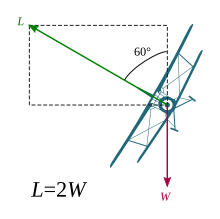
In straight and level flying, lift (Fifty) equals weight (W). In a steady level banked plough of 60°, lift equals double the weight (50 = 2W). The pilot experiences ii g and a doubled weight. The steeper the bank, the greater the g-forces.

This pinnacle-fuel dragster can advance from zero to 160 kilometres per hr (99 mph) in 0.86 seconds. This is a horizontal acceleration of 5.3 chiliad. Combining this with the vertical thou-force in the stationary case using the Pythagorean theorem yields a yard-strength of 5.4 g.
The gravitational strength equivalent, or, more commonly, thousand-force, is a measurement of the type of force per unit mass – typically acceleration – that causes a perception of weight, with a 1000-force of 1 chiliad (non gram in mass measurement) equal to the conventional value of gravitational dispatch on Earth, m, of about 9.viii m/s2 .[i] Since g-forces indirectly produce weight, whatever g-strength tin be described as a "weight per unit mass" (run into the synonym specific weight). When the g-force is produced by the surface of one object being pushed past the surface of another object, the reaction force to this push produces an equal and reverse weight for every unit of an object's[ which? ] mass. The types of forces involved are transmitted through objects past interior mechanical stresses. Gravitational acceleration (except certain electromagnetic force influences) is the cause of an object's acceleration in relation to gratis fall.[ii] [three]
The g-force experienced past an object is due to the vector sum of all non-gravitational and non-electromagnetic forces acting on an object's liberty to move. In practice, as noted, these are surface-contact forces between objects. Such forces cause stresses and strains on objects, since they must be transmitted from an object surface. Because of these strains, large yard-forces may exist destructive.
Gravity acting lone does not produce a g-force, even though chiliad-forces are expressed in multiples of the gratuitous-autumn acceleration of standard gravity. Thus, the standard gravitational force at the Earth's surface produces g-force only indirectly, as a result of resistance to information technology by mechanical forces. It is these mechanical forces that actually produce the g-force on a mass. For example, a strength of ane g on an object sitting on the Earth'south surface is caused past the mechanical forcefulness exerted in the upward direction by the ground, keeping the object from going into free autumn. The upward contact force from the ground ensures that an object at rest on the Earth'due south surface is accelerating relative to the free-fall condition. (Free fall is the path that the object would follow when falling freely toward the Globe's center). Stress inside the object is ensured from the fact that the ground contact forces are transmitted only from the signal of contact with the ground.
Objects immune to gratuitous-autumn in an inertial trajectory under the influence of gravitation just feel no grand-force, a condition known as weightlessness. This is also termed "zero-g", although the more than right term is "naught g-force". This is demonstrated by the nothing g-force conditions inside an elevator falling freely toward the Earth's center (in vacuum), or (to good approximation) weather inside a spacecraft in Earth orbit. These are examples of coordinate acceleration (a modify in velocity) without a awareness of weight.
In the absence of gravitational fields, or in directions at right angles to them, proper and coordinate accelerations are the same, and any coordinate acceleration must be produced by a corresponding g-force acceleration. An case here is a rocket in free space, in which elementary changes in velocity are produced by the engines and produce g-forces on the rocket and passengers.
Unit of measurement and measurement [edit]
The unit of measure out of acceleration in the International System of Units (SI) is m/s2. However, to distinguish acceleration relative to gratis fall from uncomplicated acceleration (rate of alter of velocity), the unit g (or g ) is often used. One chiliad is the strength per unit mass due to gravity at the Earth's surface and is the standard gravity (symbol: g n), defined as 9.80665 metres per second squared,[4] or equivalently 9.80665 newtons of forcefulness per kilogram of mass. The unit of measurement definition does not vary with location—the chiliad-force when continuing on the Moon is almost exactly 1⁄vi that on World.
The unit 1000 is not one of the SI units, which uses "thou" for gram. As well, "g" should non be confused with "G", which is the standard symbol for the gravitational constant.[five] This notation is unremarkably used in aviation, especially in aerobatic or gainsay military aviation, to draw the increased forces that must be overcome by pilots in order to remain conscious and not g-LOC (g-induced loss of consciousness).[6]
Measurement of chiliad-force is typically achieved using an accelerometer (see discussion below in Measurement using an accelerometer). In sure cases, g-forces may be measured using suitably calibrated scales. Specific force is another name that has been used for one thousand-force.
Acceleration and forces [edit]
The term g-"strength" is technically incorrect as it is a measure of acceleration, not force. While acceleration is a vector quantity, m-force accelerations ("g-forces" for short) are oftentimes expressed as a scalar, with positive thou-forces pointing downwards (indicating upward dispatch), and negative chiliad-forces pointing upward. Thus, a thou-forcefulness is a vector of acceleration. It is an acceleration that must be produced by a mechanical force, and cannot be produced by simple gravitation. Objects acted upon only past gravitation experience (or "experience") no 1000-force, and are weightless.
g-forces, when multiplied by a mass upon which they act, are associated with a sure type of mechanical force in the correct sense of the term "strength", and this strength produces compressive stress and tensile stress. Such forces issue in the operational sensation of weight, but the equation carries a sign change due to the definition of positive weight in the direction downward, and then the direction of weight-force is reverse to the direction of g-forcefulness dispatch:
- Weight = mass × −g-force
The reason for the minus sign is that the actual force (i.due east., measured weight) on an object produced by a g-strength is in the opposite management to the sign of the k-force, since in physics, weight is not the strength that produces the dispatch, merely rather the equal-and-reverse reaction force to information technology. If the direction upwards is taken equally positive (the normal cartesian convention) then positive g-force (an acceleration vector that points upward) produces a force/weight on any mass, that acts down (an instance is positive-1000 dispatch of a rocket launch, producing downward weight). In the same style, a negative-grand strength is an dispatch vector downward (the negative direction on the y centrality), and this dispatch down produces a weight-force in a direction upward (thus pulling a pilot upward out of the seat, and forcing blood toward the head of a normally oriented pilot).
If a g-strength (acceleration) is vertically upward and is applied by the ground (which is accelerating through infinite-time) or practical by the flooring of an elevator to a continuing person, almost of the body experiences compressive stress which at any superlative, if multiplied by the area, is the related mechanical strength, which is the product of the g-force and the supported mass (the mass above the level of back up, including artillery hanging downward from above that level). At the aforementioned fourth dimension, the arms themselves experience a tensile stress, which at any height, if multiplied by the area, is again the related mechanical force, which is the product of the g-force and the mass hanging below the point of mechanical support. The mechanical resistive force spreads from points of contact with the floor or supporting structure, and gradually decreases toward nil at the unsupported ends (the top in the instance of back up from below, such as a seat or the flooring, the bottom for a hanging function of the torso or object). With compressive force counted as negative tensile strength, the charge per unit of change of the tensile force in the direction of the grand-force, per unit of measurement mass (the change between parts of the object such that the slice of the object between them has unit mass), is equal to the yard-forcefulness plus the non-gravitational external forces on the slice, if any (counted positive in the direction opposite to the one thousand-force).
For a given thou-forcefulness the stresses are the same, regardless of whether this m-force is acquired past mechanical resistance to gravity, or by a coordinate-dispatch (change in velocity) caused by a mechanical strength, or by a combination of these. Hence, for people all mechanical forces feels exactly the same whether they cause coordinate acceleration or non. For objects also, the question of whether they can withstand the mechanical g-force without damage is the aforementioned for any blazon of 1000-force. For example, up acceleration (e.yard., increase of speed when going up or decrease of speed when going downward) on World feels the same every bit being stationary on a celestial body with a higher surface gravity. Gravitation acting lonely does not produce whatever g-force; chiliad-force is only produced from mechanical pushes and pulls. For a costless body (ane that is free to motion in space) such g-forces simply arise as the "inertial" path that is the natural effect of gravitation, or the natural issue of the inertia of mass, is modified. Such modification may only ascend from influences other than gravitation.
Examples of important situations involving one thousand-forces include:
- The g-force acting on a stationary object resting on the Earth'due south surface is ane chiliad (upwards) and results from the resisting reaction of the Globe's surface bearing upwards equal to an acceleration of one g, and is equal and opposite to gravity. The number 1 is approximate, depending on location.
- The grand-force interim on an object in any weightless environment such as free-fall in a vacuum is 0 thou.
- The g-force acting on an object under acceleration can be much greater than 1 one thousand, for example, the dragster pictured at top right tin exert a horizontal g-force of 5.three when accelerating.
- The g-strength acting on an object under acceleration may exist downwardly, for example when cresting a sharp hill on a roller coaster.
- If in that location are no other external forces than gravity, the thou-force in a rocket is the thrust per unit mass. Its magnitude is equal to the thrust-to-weight ratio times 1000, and to the consumption of delta-v per unit time.
- In the case of a shock, eastward.thousand., a standoff, the g-force can exist very large during a curt time.
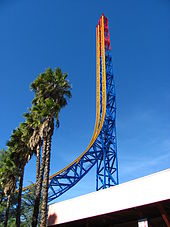
A classic example of negative g-force is in a fully inverted roller coaster which is accelerating (changing velocity) toward the ground. In this instance, the roller coaster riders are accelerated toward the footing faster than gravity would accelerate them, and are thus pinned upside downward in their seats. In this case, the mechanical force exerted by the seat causes the g-force by altering the path of the passenger downwardly in a manner that differs from gravitational acceleration. The divergence in downward motion, now faster than gravity would provide, is caused by the push button of the seat, and it results in a g-force toward the ground.
All "coordinate accelerations" (or lack of them), are described by Newton'south laws of motion as follows:
The 2d Constabulary of Motion, the police force of dispatch states that: F =ma. , significant that a force F acting on a body is equal to the mass one thousand of the body times its dispatch a.
The 3rd Law of Motion, the law of reciprocal actions states that: all forces occur in pairs, and these ii forces are equal in magnitude and opposite in direction. Newton's third law of motion means that not only does gravity carry equally a forcefulness acting down on, say, a stone held in your paw only also that the rock exerts a force on the Earth, equal in magnitude and opposite in management.

This acrobatic airplane is pulling upward in a +g maneuver; the airplane pilot is experiencing several thou's of inertial dispatch in addition to the force of gravity. The cumulative vertical centrality forces acting upon his trunk make him momentarily 'counterbalance' many times more than normal.
In an plane, the pilot's seat tin can exist thought of as the mitt holding the rock, the pilot every bit the rock. When flight straight and level at 1 g, the pilot is acted upon by the force of gravity. His weight (a downward force) is 725 newtons (163 lbf). In accord with Newton'south third law, the plane and the seat underneath the airplane pilot provides an equal and contrary force pushing upward with a force of 725 N (163 lbf). This mechanical force provides the one.0 chiliad-force upwards proper acceleration on the pilot, even though this velocity in the up direction does not change (this is similar to the state of affairs of a person standing on the ground, where the footing provides this force and this k-force).
If the airplane pilot were of a sudden to pull back on the stick and make his airplane accelerate upwards at 9.8 thousand/southtwo, the total g‑force on his body is two g, one-half of which comes from the seat pushing the pilot to resist gravity, and half from the seat pushing the pilot to cause his upwardly dispatch—a alter in velocity which also is a proper acceleration considering it also differs from a free fall trajectory. Considered in the frame of reference of the airplane his body is now generating a force of 1,450 Due north (330 lbf) downward into his seat and the seat is simultaneously pushing upwards with an equal force of i,450 N (330 lbf).
Unopposed dispatch due to mechanical forces, and consequentially g-force, is experienced whenever anyone rides in a vehicle because it e'er causes a proper acceleration, and (in the absence of gravity) as well always a coordinate acceleration (where velocity changes). Whenever the vehicle changes either direction or speed, the occupants feel lateral (side to side) or longitudinal (forwards and backwards) forces produced by the mechanical push button of their seats.
The expression "1 g = 9.80665 yard/sii " means that for every second that elapses, velocity changes 9.80665 metres per second (≡ 35.30394 km/h). This rate of change in velocity can besides be denoted as nine.80665 (metres per second) per second, or 9.80665 m/sii. For instance: An acceleration of i g equates to a charge per unit of change in velocity of approximately 35 kilometres per hour (22 mph) for each second that elapses. Therefore, if an automobile is capable of braking at 1 yard and is traveling at 35 kilometres per 60 minutes (22 mph), it can brake to a standstill in one second and the driver will experience a deceleration of 1 g. The car traveling at 3 times this speed, 105 km/h (65 mph), can brake to a standstill in three seconds.
In the case of an increase in speed from 0 to v with constant dispatch within a altitude of s this acceleration is five2/(2s).
Preparing an object for 1000-tolerance (not getting damaged when subjected to a loftier g-force) is called g-hardening.[ citation needed ] This may apply to, e.g., instruments in a projectile shot by a gun.
Human tolerance [edit]
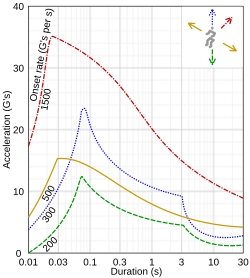
Semilog graph of the limits of tolerance of humans to linear acceleration[7]
Human tolerances depend on the magnitude of the gravitational forcefulness, the length of time information technology is applied, the direction it acts, the location of awarding, and the posture of the trunk.[8] [9] : 350
The human body is flexible and deformable, specially the softer tissues. A hard slap on the face up may briefly impose hundreds of g locally but not produce whatever real harm; a constant 16g 0 for a minute, however, may be deadly. When vibration is experienced, relatively low height g levels tin be severely dissentious if they are at the resonant frequency of organs or connective tissues.[ commendation needed ]
To some degree, yard-tolerance can be trainable, and there is as well considerable variation in innate ability between individuals. In addition, some illnesses, particularly cardiovascular problems, reduce 1000-tolerance.
Vertical [edit]
Aircraft pilots (in detail) sustain g-forces along the centrality aligned with the spine. This causes significant variation in blood pressure level forth the length of the subject area'south body, which limits the maximum thou-forces that can be tolerated.
Positive, or "up" g, drives blood downward to the feet of a seated or standing person (more naturally, the feet and body may be seen as being driven past the upwards force of the flooring and seat, upwardly around the claret). Resistance to positive g varies. A typical person can handle nigh 5g 0 (49 thou/s2) (meaning some people might pass out when riding a higher-grand roller coaster, which in some cases exceeds this betoken) earlier losing consciousness, but through the combination of special g-suits and efforts to strain muscles—both of which human action to force blood back into the brain—modern pilots can typically handle a sustained 9g 0 (88 g/southward2) (come across High-G training).
In aircraft particularly, vertical g-forces are ofttimes positive (strength blood towards the feet and away from the head); this causes problems with the eyes and brain in particular. Equally positive vertical g-forcefulness is progressively increased (such as in a centrifuge) the post-obit symptoms may be experienced:[ commendation needed ]
- Grayness-out, where the vision loses hue, hands reversible on levelling out
- Tunnel vision, where peripheral vision is progressively lost
- Blackout, a loss of vision while consciousness is maintained, caused by a lack of claret flow to the head
- 1000-LOC, a one thousand-force induced loss of consciousness[10]
- Death, if thou-forces are not quickly reduced
Resistance to "negative" or "downwardly" g, which drives blood to the head, is much lower. This limit is typically in the −2 to −threeg 0 (−20 to −29 yard/s2) range. This condition is sometimes referred to as red out where vision is figuratively reddened[eleven] due to the claret-laden lower eyelid existence pulled into the field of vision.[12] Negative m is by and large unpleasant and can cause damage. Blood vessels in the eyes or brain may swell or flare-up under the increased blood pressure, resulting in degraded sight or even blindness.
Horizontal [edit]
The man body is better at surviving g-forces that are perpendicular to the spine. In general when the dispatch is forwards (subject essentially lying on their back, colloquially known every bit "eyeballs in"),[13] a much college tolerance is shown than when the dispatch is backwards (lying on their front end, "eyeballs out") since blood vessels in the retina appear more sensitive in the latter management.[ citation needed ]
Early experiments showed that untrained humans were able to tolerate a range of accelerations depending on the fourth dimension of exposure. This ranged from as much as 20one thousand 0 for less than 10 seconds, to tenyard 0 for 1 infinitesimal, and half-dozeng 0 for 10 minutes for both eyeballs in and out.[14] These forces were endured with cognitive facilities intact, as subjects were able to perform simple concrete and advice tasks. The tests were adamant to not crusade long- or brusque-term harm although tolerance was quite subjective, with only the most motivated non-pilots capable of completing tests.[xv] The record for peak experimental horizontal 1000-force tolerance is held by dispatch pioneer John Stapp, in a series of rocket sled deceleration experiments culminating in a late 1954 test in which he was clocked in a little over a second from a land speed of Mach 0.nine. He survived a peak "eyeballs-out" acceleration of 46.2 times the acceleration of gravity, and more than 25grand 0 for 1.1 seconds, proving that the man torso is capable of this. Stapp lived another 45 years to age 89[16] without whatever ill effects.[17]
The highest recorded g-force experienced by a human who survived was during the 2003 IndyCar Serial finale at Texas Motor Speedway on October 12, 2003 in the 2003 Chevy 500 when the car driven past Kenny Bräck made wheel-to-wheel contact with Tomas Scheckter'due south car. This immediately resulted in Bräck'due south auto impacting the catch debate that would record a peak of 214chiliad 0 .[18] [19]
Short elapsing shock, bear on, and jerk [edit]
Bear on and mechanical shock are usually used to depict a loftier-kinetic-free energy, short-term excitation. A stupor pulse is oft measured by its height acceleration in ɡ 0 ·south and the pulse duration. Vibration is a periodic oscillation which can besides be measured in ɡ 0 ·s every bit well as frequency. The dynamics of these phenomena are what distinguish them from the thou-forces caused by a relatively longer-term accelerations.
Later on a costless autumn from a superlative followed past deceleration over a distance during an impact, the daze on an object is · ɡ 0 . For example, a stiff and compact object dropped from 1 m that impacts over a distance of 1 mm is subjected to a 1000 ɡ 0 deceleration.


Jerk is the rate of change of dispatch. In SI units, jerk is expressed as thousand/s3; it can also be expressed in standard gravity per second ( ɡ 0 /south; 1 ɡ 0 /s ≈ 9.81 chiliad/sthree).
Other biological responses [edit]
Contempo enquiry carried out on extremophiles in Japan involved a diverseness of bacteria (including E. coli as a not-extremophile control) being subject to weather condition of extreme gravity. The bacteria were cultivated while being rotated in an ultracentrifuge at loftier speeds corresponding to 403,627 k. Paracoccus denitrificans was one of the bacteria that displayed not simply survival merely also robust cellular growth under these conditions of hyperacceleration, which are usually only to be establish in cosmic environments, such as on very massive stars or in the shock waves of supernovas. Analysis showed that the minor size of prokaryotic cells is essential for successful growth under hypergravity. Notoriously, ii multicellular species, the nematodes Panagrolaimus superbus [xx] and Caenorhabditis elegans were shown to be able to tolerate 400,000 x g for i hr.[21] The inquiry has implications on the feasibility of panspermia.[22] [23]
Typical examples [edit]
| Case | chiliad-strength* |
|---|---|
| The gyro rotors in Gravity Probe B and the complimentary-floating proof masses in the TRIAD I navigation satellite[24] | 0 thou |
| A ride in the Vomit Comet (parabolic flight) | ≈ 0 g |
| Standing on Mimas, the smallest and least massive known torso rounded past its own gravity | 0.006 1000 |
| Standing on Ceres, the smallest and least massive known torso currently in hydrostatic equilibrium | 0.029 k |
| Standing on Pluto at sea level | 0.063 thousand |
| Standing on Eris at ocean level | 0.084 g |
| Continuing on Titan at body of water level | 0.138 g |
| Continuing on Ganymede at ocean level | 0.146 g |
| Continuing on the Moon at body of water level | 0.1657 g |
| Standing on Mercury at ocean level | 0.377 thousand |
| Standing on Mars at its equator | 0.378 m |
| Standing on Venus at sea level | 0.905 g |
| Standing on Earth at sea level–standard | 1 g |
| Saturn Five moon rocket just subsequently launch and the gravity of Neptune where atmospheric pressure is about Earth's | 1.xiv k |
| Bugatti Veyron from 0 to 100 km/h in 2.4 s | ane.55 g† |
| Gravitron entertainment ride | 2.5-3 g |
| Gravity of Jupiter at its mid-latitudes and where atmospheric pressure is about Earth'south | 2.528 yard |
| Uninhibited sneeze after sniffing ground pepper[25] | ii.9 thou |
| Space Shuttle, maximum during launch and reentry | 3 g |
| High-g roller coasters[nine] : 340 | iii.5–half-dozen.iii g |
| Hearty greeting slap on upper dorsum[25] | 4.1 g |
| Peak Fuel drag racing globe record of four.4 southward over 1/iv mile | 4.2 g |
| First world war aircraft (ex:Sopwith Camel, Fokker Dr.ane, SPAD S.XIII, Nieuport 17, Albatros D.III) in dogfight maneuvering. | four.five–seven g |
| Luge, maximum expected at the Whistler Sliding Centre | 5.2 chiliad |
| Formula One auto, maximum nether heavy braking[26] | half-dozen.3 g |
| Formula 1 automobile, peak lateral in turns[27] | 6–6.v g |
| Standard, full aerobatics certified glider | +7/−v one thousand |
| Apollo 16 on reentry[28] | 7.19 g |
| Maximum permitted g-forcefulness in Sukhoi Su-27 plane | nine g |
| Maximum permitted thou-force in Mikoyan MiG-35 plane and maximum permitted one thousand-strength turn in Red Bull Air Race planes | 10 1000 |
| Gravitational dispatch at the surface of the Sun | 28 thou |
| Maximum g-strength in Tor missile system[29] | 30 thousand |
| Maximum for human on a rocket sled | 46.ii g |
| Formula One 2022 British Grand Prix Max Verstappen Crash with Lewis Hamilton | 51 g |
| Formula One 2022 Bahrain Grand Prix Romain Grosjean Crash[30] | 67 g |
| Sprint missile | 100 chiliad |
| Brief human being exposure survived in crash[31] | > 100 1000 |
| Highest 1000-strength e'er survived (IRL IndyCar Serial 2003 Kenny Bräck Crash) | 214 g |
| Coronal mass ejection (Sun)[32] | 480 g |
| Space gun with a butt length of ane km and a muzzle velocity of 6 km/s, equally proposed by Quicklaunch (assuming abiding acceleration) | 1,800 chiliad |
| Shock adequacy of mechanical wrist watches[33] | > v,000 yard |
| V8 Formula Ane engine, maximum piston acceleration[34] | eight,600 g |
| Mantis Shrimp, acceleration of hook during predatory strike[35] | 10,400 one thousand |
| Rating of electronics congenital into armed forces artillery shells[36] | 15,500 thou |
| Analytical ultracentrifuge spinning at sixty,000 rpm, at the bottom of the analysis prison cell (vii.two cm)[37] | 300,000 one thousand |
| Mean dispatch of a proton in the Large Hadron Collider[38] | 190,000,000 g |
| Gravitational acceleration at the surface of a typical neutron star[39] | 2.0×ten11 g |
| Acceleration from a wakefield plasma accelerator[40] | 8.9×10²⁰ g |
* Including contribution from resistance to gravity.
† Directed xl degrees from horizontal.
Measurement using an accelerometer [edit]
An accelerometer, in its simplest form, is a damped mass on the end of a spring, with some way of measuring how far the mass has moved on the spring in a particular management, called an 'axis'.
Accelerometers are often calibrated to measure g-force along one or more axes. If a stationary, unmarried-axis accelerometer is oriented and then that its measuring axis is horizontal, its output volition be 0 thousand, and it volition continue to be 0 g if mounted in an automobile traveling at a constant velocity on a level road. When the driver presses on the brake or gas pedal, the accelerometer will register positive or negative acceleration.
If the accelerometer is rotated past 90° then that it is vertical, it will read +1 one thousand upwardly even though stationary. In that situation, the accelerometer is subject area to two forces: the gravitational force and the ground reaction force of the surface it is resting on. Only the latter force tin can exist measured past the accelerometer, due to mechanical interaction between the accelerometer and the ground. The reading is the acceleration the musical instrument would have if it were exclusively subject field to that force.
A three-centrality accelerometer volition output nix‑k on all three axes if it is dropped or otherwise put into a ballistic trajectory (also known every bit an inertial trajectory), so that information technology experiences "gratuitous fall," as practise astronauts in orbit (astronauts experience small-scale tidal accelerations called microgravity, which are neglected for the sake of discussion here). Some amusement park rides can provide several seconds at well-nigh-zero one thousand. Riding NASA'south "Vomit Comet" provides most-zero g for near 25 seconds at a fourth dimension.
See also [edit]
- Artificial gravity
- World'southward gravity
- Euthanasia Coaster
- Gravitational dispatch
- Gravitational interaction
- Load factor (aeronautics)
- Tiptop footing acceleration – one thousand-strength of earthquakes
- Relation between m-strength and apparent weight
- Shock and vibration information logger
- Daze detector
References [edit]
- ^ Deziel, Chris. "How to Convert Newtons to Chiliad-Force". sciencing.com . Retrieved 17 January 2021.
- ^ G Force. Newton.dep.anl.gov. Retrieved on 2011-10-fourteen.
- ^ Sircar, Sabyasachi (12 December 2007). Principles of Medical Physiology. ISBN978-i-58890-572-7.
- ^ BIPM: Declaration on the unit of measurement of mass and on the definition of weight; conventional value of gn.
- ^ Symbol g: ESA: GOCE, Basic Measurement Units, NASA: Multiple Thousand, Astronautix: Stapp Archived 2009-03-21 at the Wayback Machine, Honeywell: Accelerometers Archived 2009-02-17 at the Wayback Motorcar, Sensr LLC: GP1 Programmable Accelerometer Archived 2009-02-01 at the Wayback Motorcar, Farnell: accelometers [ permanent expressionless link ] , Delphi: Accident Data Recorder 3 (ADR3) MS0148 Archived 2008-12-02 at the Wayback Machine, NASA: Constants and Equations for Calculations Archived 2009-01-18 at the Wayback Car, Jet Propulsion Laboratory: A Give-and-take of Diverse Measures of Altitude Archived 2009-02-10 at the Wayback Motorcar, Vehicle Rubber Research Heart Loughborough: Use of smart technologies to collect and retain crash data, National Highway Traffic Safety Administration: Recording Automotive Crash Event Data Archived 5 April 2010 at the Wayback Machine
Symbol G: Lyndon B. Johnson Space Center: Ecology FACTORS: BIOMEDICAL RESULTS OF APOLLO, Department 2, Chapter v Archived 2008-xi-22 at the Wayback Car, Honywell: Model JTF, General Purpose Accelerometer Archived March 2, 2009, at the Wayback Machine - ^ "Pulling One thousand's". Go Flight Medicine. 5 April 2013. Retrieved 24 September 2014.
- ^ Robert V. Brulle (2008). Engineering the Space Age: A Rocket Scientist Remembers (PDF). Air University Press. p. 135. ISBN978-1-58566-184-8. Archived from the original (PDF) on 4 January 2017. Retrieved 8 January 2020.
- ^ Balldin, Ulf I. (2002). "Chapter 33: Acceleration effects on fighter pilots." (PDF). In Lounsbury, Dave E. (ed.). Medical conditions of Harsh Environments. Vol. 2. Washington, DC: Office of The Surgeon General, Section of the Army, United States of America. ISBN9780160510717. OCLC 49322507. Retrieved 16 September 2013.
- ^ a b George Bibel. Beyond the Blackness Box: the Forensics of Airplane Crashes. Johns Hopkins Academy Press, 2008. ISBN 0-8018-8631-vii.
- ^ Burton RR (1988). "Yard-induced loss of consciousness: definition, history, current status". Aviation, Space, and Environmental Medicine. 59 (1): two–five. PMID 3281645.
- ^ Brown, Robert One thousand (1999). On the border: Personal flying experiences during the Second World War. ISBN978-one-896182-87-2.
- ^ DeHart, Roy L. (2002). Fundamentals of Aerospace Medicine: 3rd Edition. Lippincott Williams & Wilkins.
- ^ "NASA Physiological Dispatch Systems". xx May 2008. Archived from the original on twenty May 2008. Retrieved 25 December 2012.
- ^ NASA Technical notation D-337, Centrifuge Study of Pilot Tolerance to Acceleration and the Effects of Acceleration on Pilot Functioning, by Brent Y. Creer, Helm Harald A. Smedal, USN (MC), and Rodney C. Wingrove, figure 10
- ^ NASA Technical note D-337, Centrifuge Study of Airplane pilot Tolerance to Dispatch and the Furnishings of Acceleration on Airplane pilot Performance, by Brent Y. Creer, Captain Harald A. Smedal, USN (MC), and Rodney C. Vtlfngrove
- ^ Fastest Man on Globe – John Paul Stapp. Ejection Site. Retrieved on 2011-x-14.
- ^ Martin, Douglas (16 November 1999). "John Paul Stapp, 89, Is Expressionless; 'The Fastest Man on Earth'". The New York Times . Retrieved 29 Oct 2016.
- ^ "New details from horror crash". News.com.au. sixteen October 2014. Retrieved thirty Dec 2017.
- ^ "Q&A: Kenny Brack". Crash.net. 13 October 2004. Retrieved 30 December 2017.
- ^ de Souza, T.A.J.; et al. (2017). "Survival potential of the anhydrobiotic nematode Panagrolaimus superbus submitted to extreme abiotic stresses. ISJ-Invertebrate Survival Journal". Invertebrate Survival Journal. fourteen (1): 85–93. doi:10.25431/1824-307X/isj.v14i1.85-93.
- ^ de Souza, T.A.J.; et al. (2018). "Caenorhabditis elegans Tolerates Hyperaccelerations upward to 400,000 x g. Astrobiology". Astrobiology. 18 (7): 825–833. doi:ten.1089/ast.2017.1802. PMID 29746159. S2CID 13679378.
- ^ Than, Ker (25 April 2011). "Bacteria Grow Under 400,000 Times Earth'southward Gravity". National Geographic- Daily News. National Geographic Society. Retrieved 28 April 2011.
- ^ Deguchi, Shigeru; Hirokazu Shimoshige; Mikiko Tsudome; Sada-atsu Mukai; Robert Westward. Corkery; Susumu Ito; Koki Horikoshi (2011). "Microbial growth at hyperaccelerations up to 403,627 × 1000". Proceedings of the National Academy of Sciences. 108 (19): 7997–8002. Bibcode:2011PNAS..108.7997D. doi:10.1073/pnas.1018027108. PMC3093466. PMID 21518884.
- ^ Stanford University: Gravity Probe B, Payload & Spacecraft, and NASA: Investigation of Elevate-Free Control Engineering science for Earth Science Constellation Missions. The TRIAD i satellite was a later, more advanced navigation satellite that was part of the U.S. Navy'south Transit, or NAVSAT system.
- ^ a b Allen 1000.E.; Weir-Jones I; et al. (1994). "Dispatch perturbations of daily living. A comparison to 'whiplash'". Spine. xix (11): 1285–1290. doi:10.1097/00007632-199405310-00017. PMID 8073323. S2CID 41569450.
- ^ FORMULA one (31 March 2017). "F1 2022 v 2016: G-Force Comparison". YouTube. Archived from the original on thirty October 2021. Retrieved 30 Dec 2017.
- ^ 6 g has been recorded in the 130R turn at Suzuka circuit, Nippon. "Archived re-create". Archived from the original on 28 Feb 2010. Retrieved 12 October 2012.
{{cite spider web}}: CS1 maint: archived copy as title (link) Many turns have 5 g peak values, like turn viii at Istanbul or Eau Rouge at Spa - ^ NASA: Table 2: Apollo Manned Infinite Flight Reentry G Levels Lsda.jsc.nasa.gov
- ^ "Russia trains Greek Tor-M1 crews". RIA Novosti. 2007-12-27. Retrieved 2008-09-04.
- ^ "FIA CONCLUDES INVESTIGATION INTO ROMAIN GROSJEAN'S ACCIDENT AT 2022 BAHRAIN FORMULA 1 GRAND PRIX AND RELEASES 2022 Circuit RACING SAFETY INITIATIVES". world wide web.fia.com. 5 March 2021. Retrieved twenty July 2021.
- ^ "Several Indy car drivers accept withstood impacts in excess of 100 G without serious injuries." Dennis F. Shanahan, M.D., K.P.H.: "Human Tolerance and Crash Survivability Archived 2013-11-04 at the Wayback Car, citing Society of Automotive Engineers. Indy racecar crash analysis. Automotive Engineering International, June 1999, 87–90. And National Highway Traffic Safety Assistants: Recording Automotive Crash Effect Data Archived 5 April 2010 at the Wayback Auto
- ^ Fang Shen, Due south. T. Wu, Xueshang Feng, Chin‐Chun Wu (2012). "Acceleration and deceleration of coronal mass ejections during propagation and interaction". Infinite Physics. 117 (A11): due north/a. Bibcode:2012JGRA..11711101S. doi:10.1029/2012JA017776.
{{cite periodical}}: CS1 maint: multiple names: authors listing (link) - ^ "OMEGA Watches: FAQ". 10 February 2010. Archived from the original on 10 February 2010. Retrieved 30 December 2017.
{{cite web}}: CS1 maint: bot: original URL status unknown (link) - ^ "F1: Stunning data about the Cosworth V-eight Formula 1 engine - Auto123.com". Auto123.com . Retrieved 30 Dec 2017.
- ^ Southward. N. Patek, W. L. Korff & R. Fifty. Caldwell (2004). "Deadly strike mechanism of a mantis shrimp" (PDF). Nature. 428 (6985): 819–820. Bibcode:2004Natur.428..819P. doi:10.1038/428819a. PMID 15103366. S2CID 4324997. Archived from the original (PDF) on 26 January 2021. Retrieved 13 June 2018.
- ^ "L3 IEC". Iechome.com. Archived from the original on 21 February 2011. Retrieved 30 December 2017.
- ^ (rpm·π/xxx)2·0.072/thou
- ^ (seven TeV/(twenty minutes·c))/proton mass
- ^ Greenish, Simon F.; Jones, Mark H.; Burnell, Southward. Jocelyn (2004). An Introduction to the Dominicus and Stars (illustrated ed.). Cambridge University Printing. p. 322. ISBN978-0-521-54622-v. Excerpt of page 322 note: 2.00×x12 ms−two = 2.04×ten11 g
- ^ (42 GeV/85 cm)/electron mass
Further reading [edit]
- Faller, James E. (November–December 2005). "The Measurement of Little g: A Fertile Footing for Precision Measurement Scientific discipline". Journal of Research of the National Institute of Standards and Technology. 110 (6): 559–581. doi:10.6028/jres.110.082. PMC4846227. PMID 27308179.
External links [edit]
- "How Many Gs Tin can a Flyer Take?", October 1944, Popular Science—ane of the first detailed public articles explaining this subject
- Indelible a homo centrifuge at the NASA Ames Research Center at Wired
Source: https://en.wikipedia.org/wiki/G-force
0 Response to "How Much G Force Can a Human Handle"
Enregistrer un commentaire