Is Tree From Line Freezes Will It Ever Grow Limes Ever Again Will It Produce Food Afterwards
Quick facts
- Apple trees need at to the lowest degree 8 hours of sun per day during the growing flavor.
- Two varieties are required for successful pollination; one tin can exist a crabapple.
- Dwarf apple trees will start bearing fruit 2 to 3 years after planting.
- Standard size trees can take up to 8 years to bear fruit.
- Some varieties are more susceptible to insect and disease impairment than others.
- Prune annually to proceed apple tree trees salubrious and productive.
Two trees can provide enough of apples
Apples are pollinated by insects, with bees and flies transferring pollen from flowers of one apple tree to those of another. But you lot don't demand to found a whole orchard to enjoy apples right off the tree. Ii trees volition reward any family unit with enough fruit to enjoy and share with friends.
Apples require pollen from a different apple tree variety to grow fruit. If you lot simply have room in your m for i tree, in that location may exist crab apples in your neighborhood to provide the pollen your tree needs.
Virtually apple tree trees are grafted onto dwarfing rootstocks and but grow to exist nigh 8-10 anxiety tall. So even if you lot're short on space, you probably have space for two copse.
Care through the seasons
-
March—For existing trees, clip earlier growth begins, after coldest weather has passed
- Apr, May—Plant bare root trees as soon as the soil tin be worked
- Apr, May—If last yr's growth was less than 12 inches, apply compost around the base of tree
- May, June—Plant potted trees subsequently threat of frost has passed
- May, June—As flower buds begin to turn pink, start watching for insect and illness symptoms
- May through October—Water trees equally you would any other tree in your m
- June, July—Thin fruit
- remove smallest apples to encourage larger fruit
- August through October—Harvest
- gustatory modality fruit when it appears to exist fully colored
- if it's also starchy, wait a few days
- Oct, November—Rake up fallen leaves and fruit; compost or discard
- November—Apply tree wrap to prevent winter injury
- November through March—Look for deer and vole damage; put fencing effectually tree if needed
Selecting plants
Before choosing an apple to plant, take a look effectually your neighborhood. A pollen source should be inside 100 feet of the apple tree you plant to ensure the pollen gets to your tree.
If you lot don't see any crabapples or other apple tree trees that close, your best bet is to plant two trees of different varieties.
When purchasing an apple, you are actually selecting a plant made upwards of two genetically dissimilar individuals grafted together, the scion and the rootstock.
- The scion is the aboveground part of the tree that produces the type of fruit desired (ex. Honeycrisp or Haralson).
- The rootstock plays a major role in determining the tree's ultimate size and how long it volition take to bear fruit.
Variety tables provide hardiness, size and compatibility information for apple varieties that have proven to do well in northern climates.
|
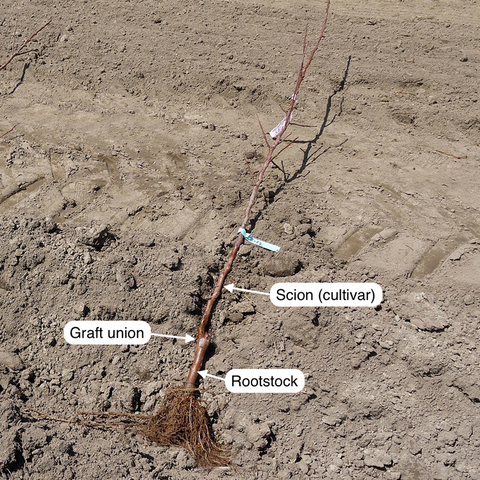
If you have limited infinite, pay detail attention to the rootstock yous cull for your apple trees.
Often nurseries volition label the trees dwarfing, semi-dwarfing, and standard. These labels are referring to the rootstock, which determines how tall your tree will grow.
If you lot have an interest in a specific rootstock, talk with your local nursery. They might be able to social club a tree for you.
Otherwise, you might want to guild trees from a nursery that grafts each fruit diversity on various rootstocks to go the combination you want.
- Bulb or standard rootstocks may crusade the tree to grow 20 or more than feet alpine.
- Dwarfing rootstocks reduce tree size by upward to 50 percent, so that a tree may be but 8, 12, or fifteen feet tall when mature, depending upon its rootstock, scion variety, and growing conditions.
- Whether the fruiting variety is grafted onto standard or dwarfing rootstock, the fruit size and quality will be the aforementioned.
Seedling or standard rootstock
- Abound to 20 or more anxiety alpine
- Produce up to 10 bushels of fruit per tree
Pluses
- More than tolerant of wetter and drier soils
- Better anchored than dwarf trees
Minuses
- May need 8 or more than years to start bearing fruit
- More complicated pruning, thinning, harvesting
- More difficult to control pests
Dwarfing rootstock
- Grow to eight, 12, or 15 feet tall (40-80% shorter than standard)
- Produce 2 to three bushels of fruit per tree
Pluses
- Simpler pruning, thinning, harvesting
- Easier to control pests
- Require only 3-4 years to start bearing fruit
- Tin can fit two or 3 copse into a modest space
Minuses
- Tin fall over more easily and may need to exist anchored
- May exist more prone to some diseases
Common rootstock for Minnesota
Bulb
A bulb rootstock is really grown from the seed of an apple, often McIntosh or another common, hardy variety. Although you won't know exactly what yous're getting with a seedling rootstock—every single seed is a genetically different individual —hardiness, anchorage and adaptability to unlike soil types are generally fantabulous.
MM.111
This rootstock, sometimes termed 'semi-dwarfing,' other times 'semi-standard,' produces a tree virtually 80% of the height of a standard tree. In many areas of Minnesota, this tin can work out to roughly a xiv-18 human foot tree.
MM.111 is a hardy, well-anchored rootstock that tin withstand drier soil conditions, making information technology an splendid choice especially for western parts of the country.
M.9 (besides: EMLA nine – virus-free)
This rootstock performs well under many conditions and produces a tree 40-50% the height of a standard tree. It produces fruit very early in the life of the tree.
Grand.ix has poor anchorage due to brittle roots and a high fruit to wood ratio which means it requires staking for the life of the tree. M.ix is very susceptible to fire blight. It produces moderate amounts of root suckers and burr knots.
Grand.26 (also: EMLA 26 – virus-complimentary)
This dwarfing rootstock produces a tree viii-x feet in height. Copse planted on M.26 more often than not crave staking for the get-go few years of growth or, on windy sites, for the life of the tree.
M.26 is reliably hardy, but is especially susceptible to fire blight. Fruit is produced very early in the tree'south life, sometimes within three years from planting.
Print expanded content.
Apple varieties for home orchards and gardens
Academy of Minnesota varieties are in bold and include their release engagement.
Print expanded content.
Planting and caring for young trees
Learn how to choose a location, prepare for planting and space trees.
|
Find a sunny location
Apple tree trees require full sun, so choose a spot where the sun shines direct on the tree for at to the lowest degree 8 hours each day.
Exam your soil
When it comes to soil, apple copse can abound in most soils as long as at that place is no standing water and the pH of the soil is betwixt 6 and 7.
- Have your soil tested to determine pH
- pH of the soil should be between 6 and 7
- Apple trees tin can grow in nigh soils as long every bit at that place is no standing water
- Avoid planting in areas where water stands for several hours after a rain
If you are unsure about your soil pH, conduct a soil examination to decide soil conditions before planting and meliorate the soil every bit suggested by the results.
Spacing
How much infinite do you demand for apple trees? A expert rule of pollex for a garden fruit tree is to provide at to the lowest degree as much horizontal space as the anticipated superlative of the tree. So, if your tree will grow up to 8 anxiety high, make sure there are eight feet between it and the next tree.
Planting copse too close together will increment shading and reduce the number and quality of the fruit coming from your tree.
Tree spacing
- Standard trees: twenty-25 feet
- Semi-dwarf trees: 12-fifteen feet
- Dwarf trees: vi-8 feet
Print expanded content.
Dig a pigsty
- Dig a hole for each tree that is no deeper than the root ball, and about twice equally wide.
- When you dig the soil out of the hole, pile information technology on a tarp or piece of plywood so it's easier to get it back in the hole.
- You may mix in up to i-tertiary by volume compost, peat moss or other organic matter.
- Nearly of what goes back in the planting pigsty should exist the soil you took out of the hole.
- There is no demand to add fertilizer to the hole.
Look at the roots
- If y'all purchased bare root trees, closely examine the root system and remove encircling roots or J-shaped roots that could eventually strangle the trunk.
- For trees in containers, audit the root systems for encircling woody roots.
- If woody roots are wrapped around in a circle, straighten them or make several cuts through the root brawl prior to planting.
- This helps the plant produce a stronger root system and prevents the formation of girdling roots that eventually weaken the tree.
Put the tree in the hole
- Position each tree so that the graft union is virtually 4 inches above the soil line. The graft wedlock is a swelling where the variety meets the rootstock.
- If the graft wedlock is placed close to or below the soil line, the variety (scion) will root, causing trees to grow to total size.
- Spread the roots of blank root trees, making certain none are bent.
- Take someone help you get the tree standing up straight.
- Begin calculation the soil, tamping to remove air pockets equally yous go.
- After the hole is filled, tamp gently and water thoroughly to remove remaining air pockets.
- The soil may settle an inch or two. If this happens, add more than soil.
Impress expanded content.
Video courtesy of Jon Clements, University of Massachusetts (00:3:47)
How to keep your apple trees healthy and productive
From watering to weeding to thinning fruit, caring for your apple trees throughout the year will help your plants produce plenty of apples to harvest.
|
Watering
Throughout the life of the tree, you lot should water its root zone thoroughly during the growing season whenever there is a dry out spell. Ideally, the tree should receive one inch of water from rainfall or irrigation every week from May through October.
Support
It's a good idea to stake the tree for the outset few years. Either a wooden or metal stake will work. A stake should be about the pinnacle of the tree after being pounded two anxiety into the basis. Employ a wide piece non-annoying fabric to fasten the tree to the stake. Avoid narrow fastenings such as wire or twine, every bit they may cutting into the bark.
Use tree guards to protect the body of your tree
Planting is a good time to install a tree guard. These are usually made of plastic and are available at nearly nurseries and online.
Tree guards protect your tree from winter injury and bark chewing by modest mammals, such as voles (aka meadow mice) and rabbits.
Guards also reflect sunlight from the body, which helps prevent the torso from heating upwards on a cold, sunny winter twenty-four hours.
- If the bark temperature gets above freezing, water in the conductive tissue under the bawl becomes liquid and begins to catamenia through the cells.
- When the sun goes down or behind a cloud, the liquid water all of a sudden freezes, dissentious the cells and sometimes killing all the tissue on one side of the trunk. This is chosen sunscald.
Once the tree has rough and flaky mature bark, neither winter sunday nor chewing animals tin harm it, so tree guards will not be necessary. For the kickoff years of its life, even so, information technology's important to protect the torso of your fruit tree.
Fertilizer and mulch
Once established, an apple tree planted on a favorable site, in properly prepared soil, should thrive with minimal fertilization.
- Nitrogen is normally the simply mineral food that needs to be added on an annual basis and can exist added using compost.
- The branches of non-bearing immature apple trees volition unremarkably grow 12 to xviii inches per twelvemonth while the branches of bearing apple trees will grow 8 to 12 inches in a flavour.
- If growth exceeds these rates, apply no compost at all, as too much growth tin keep fruit from developing, and lush growth is more susceptible to fireblight infection.
Weeding
- For the starting time iii to five years, grass and weeds should be removed from well-nigh a 3-foot radius effectually the tree.
- Grasses can deplete soil wet chop-chop and will reduce tree growth.
- Applying a few inches of mulch around the base of the tree will assistance forbid weeds.
- Keep the mulch a few inches abroad from the trunk to prevent rodent damage and fungal growth.
Impress expanded content.
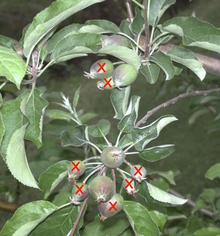
An apple tree will provide an abundant crop if conditions are favorable when the tree is in bloom.
Some of the fruit will naturally drop off the tree in mid June, but the tree may exist left with more fruit than it can support.
Besides heavy crops tin can cause biennial bearing, when a heavy crop of small, green apples is followed past little or no crop the adjacent yr.
- Thinning fruit off the copse by hand will minimize biennial bearing and promote larger, higher quality fruit.
- Get out one or 2 fruit per blossom cluster or, for the best fruit quality, almost 4 to 6 inches betwixt fruit on any branch.
- Thin when fruit is about marble size, in tardily June or early July, after some of the fruit has already dropped naturally.
- Thinning improves the quality of the apples you'll harvest in the fall.
- You'll be more likely to get fruit every yr.
See the Farmbytes video Thin apples for better harvests.
Print expanded content.
Know when to pick
The color of an apple is only 1 indicator of its ripeness. Sweetness is an indicator of maturity and harvest-readiness along with fruit size and color. There is a popular thought that some later apple varieties need a frost to sweeten them before picking. Notwithstanding, apples will ripen and sweeten up without a frost.
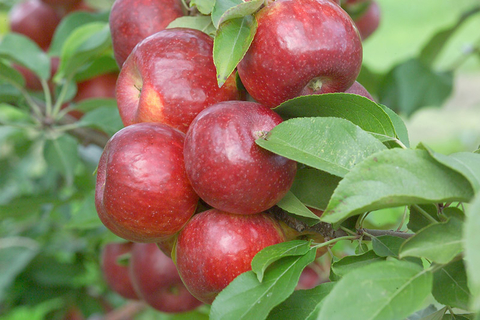
How to tell if an apple is ripe
- Await for a change in the background color, the role of the pare not covered with scarlet color.
- When the background colour (also called ground colour) begins to alter from dark-green to a greenish xanthous color, the apple is starting to ripen.
- Other than Honeygold, all other apples nosotros recommend should have a green-turning-to-xanthous background color when fully ripened.
- Pick a few apples that seem ripe and taste them to be sure they are at the ripeness you prefer.
- As apples ripen, starch in the flesh is converted to sugar. An unripe apple will be starchy and leave a pasty film on your teeth.
- A ripe apple may still be tart, but it should accept developed aromatic flavors.
- Yous may demand to pick the fruit from the aforementioned tree several times over the course of a week or ii in order to get all the fruit at the correct stage of maturity.
- Check the UMN Minnesota Hardy website to see what time in the flavor your apple variety typically ripens.
How to pick an apple
- Gently take the fruit in the palm of your hand, then elevator and twist in a single move.
- Or use one hand to hold the short, thick fruiting spur that bore the apple, and the other manus to lift and twist the fruit.
- Avoid pulling or yanking the fruit as y'all could pull off the spur, taking with it next year'due south bloom buds.
Storing apples
Apples last the longest at standard refrigerator temperatures, about 33°F to 38°F, with nearly 85 percent humidity. Although garages, basements and root cellars may provide acceptable storage weather, the all-time place to store apples at habitation is usually the refrigerator.
- Warmer temperatures e'er shorten the storage life of apples.
- Apples stored nigh 33°F may last as much every bit x times longer than apples stored at room temperature.
- High humidity helps reduce the shriveling of apples in storage.
- If the storage environment is low in humidity, as virtually refrigerators are, the fruit should exist stored in a perforated plastic bag or a loosely covered container.
- Although apples are lovely displayed in a fruit basin, such weather will dramatically reduce their usable life.
Volition apples be affected by a hard freeze?
A "difficult freeze" is defined as four straight hours of 28°F. While 32°F is the freezing temperature for h2o, it is not the freezing temperature for most fruits. Fruits such equally apples, grapes, and strawberries are high in sugar. The sugar in the fruit's juice reduces the temperature at which the fruit freezes.
- Apple tree fruit starts freezing at effectually 28-28.5°F, but apples should exist okay provided the temperature doesn't fall much beneath 28.
- The longer apples are exposed to temperatures beneath 28 degrees, the higher the chance that they will get damaged.
- Frozen apples should not be picked until the fruit thaws out, equally the frozen fruit will bruise and exist unusable.
- After a freeze, get out the apples on the tree and wait until midday when they have thawed out.
- Late fruiting apples like U of Grand's SnowSweet® and Haralson are more at risk of freezing because they are more than likely to still be on the trees when a freeze hits.
A brief dip beneath 28 degrees may but weaken the apples enough to decrease their shelf life. Several nights beneath 28 degrees are more likely to soften the skin and flesh of the apple, making the fruit unusable.
At 22°F, the fruit will freeze hard and cells will suspension downwards, making the fruit soft. If but a brief freeze happens and the fruit is however house, use the fruit soon, every bit it may non store well.
Print expanded content.
Pruning and training apple trees
Clip a tree to have well-spaced branches and a balanced appearance, while eliminating broken, diseased or dead branches.
|
General pruning guidelines
- Remove diseased, cleaved, or expressionless branches
- Remove whatever downwards-growing branches
- If 2 limbs are crossed, entangled, or otherwise competing, remove i of them completely at its base
- Remove any limbs along the torso that are bigger in bore than the trunk
- Remove suckers coming up from the roots or low on the trunk
- Remove vigorous vertical branches, called watersprouts
- Make pruning cuts close to the branch collar at the base of the limb
- For larger limbs, start the cut from the underside of the limb to avoid vehement the bark
- Remove large limbs first, starting with the summit of the tree
- "Thinning" cuts remove entire branches at the branch collar and are usually the recommended type of cut
- "Heading" cuts remove but office of a co-operative and encourage vegetation growth beneath the cut and are non as common
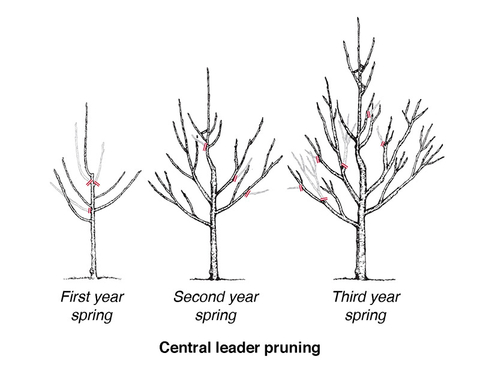
Fruit trees should be pruned every year in belatedly winter/early on spring, preferably later the coldest weather condition is past, and before growth begins. Prune minimally, peculiarly with young trees, every bit excessive pruning volition delay or reduce fruiting and create too much leafy growth.
Once the start ready of scaffold branches has been selected, select a second set above it. Scaffold branches should be spaced about 12 inches apart. E'er keep the conical form in mind when pruning.
Many apple trees are pruned and trained to allow a fundamental main stalk, or leader, to be the foundation of the tree off of which side branches, or scaffolds grow. The tree ends up with a conical or pyramid course. This is called central leader pruning. This is a simple pruning method, and it makes for a compact, balanced, easily managed tree, with fruit that has maximum admission to sunlight and air circulation.
How to prune apple copse: A 3-part video series
Have you moved into a house that has an old, overgrown apple tree? Are the branches overlapping and going every which mode? Don't lose hope. This tree is probably fine, it just needs a picayune work to get it back in shape and productive again.
Reclaiming a mature apple tree tree that has been neglected for several years tin be a challenge, and will accept a few years of pruning to brand the tree productive again. Here are a few guidelines for renovating a neglected tree:
- Decide which branch is or will be the leader
- Then decide which branches y'all are going to save based on the branch position around the torso
- At this stage, pruning out a few large branches in year ane will open the tree upwards, increase calorie-free and air flow
- Don't prune too much or the tree volition put all its free energy into making new branches and not fruit!
- During year 2, brand a few more than decisions on where branches should remain and remove a few more
- Follow the general pruning guidelines to prune out branches that are diseased or broken
Print expanded content.
As you prune your young tree to reach a good form, you may as well need to train information technology. Training primarily consists of angle immature, flexible branches that are growing vertically into more horizontal positions, toward a lx degree bending from the main stalk. Some apple tree varieties produce strongly vertical growth and need more training; others tend to produce branches that are naturally well-angled.
- Training branches at virtually a 60 degree bending from the main stem slows down the product of new leaves and branch growth, and encourages fruiting.
- The more vertical a branch, the more than vigorously it grows, and the less fruit information technology tends to produce.
- Branches that accept relatively wide crotch angles are also stronger and better able to back up the weight of the crop.
- Branches that grow more vertically frequently pause away from the tree under the weight of fruit.
- Don't train a branch to be truly horizontal or to grow downwards; it should notwithstanding be growing more or less upward.
If a young co-operative is well placed, merely has a narrow branch angle, the utilize of a device chosen a "spreader" may help. The spreader can exist every bit simple as a notched stick, or you lot can detect them at garden centers. It is wedged in betwixt the branch and the trunk to create a wider angle.
- To train new branches less than six inches in length, utilize a wooden spring-blazon clothespin.
- Prune the clothespin onto the leader and position the flexible shoot between the other ends of the clothespin.
- Motion the clothespin up or down the leader until you have the young shoot at the proper bending.
- E'er become back and remove the spreaders at the end of the growing flavor.
Print expanded content.
Managing pests and diseases
Many things tin bear upon apple trees, leaves, flowers and fruits. Changes in physical appearance and constitute wellness can be acquired past the environment, plant diseases, insects and wildlife. In order to address what you're seeing, it is important to make a right diagnosis.
Yous can find additional help identifying common pest problems by using the online diagnostic tools What insect is this? and What'southward wrong with my plant? or past sending a sample to the UMN Plant Disease Diagnostic Clinic. You can use Enquire a Master Gardener to share pictures and get advice.
Note that but considering you are seeing some harm doesn't mean all hope is lost. 1 apple tree volition produce a lot of apples, so losing a small-scale number to birds and bugs isn't a reason to stress.
|
There are several unlike insect pests of apples, some of which you may see every year, while others you may rarely encounter. Uncomplicated activities like removing dropped apples and cleaning up foliage litter in the fall volition aid manage multiple pests.
Most of the time, apples damaged by insects can still be eaten once the damaged portions are removed.
- Apple maggot can be the most destructive of all the insects that set on apples.
- Codling moth is also a common pest of Minnesota apples, with larvae feeding on developing seeds inside the apple before exiting the fruit.
- Plum curculio is a weevil (small protrude with a distinct snout) that lays eggs on developing fruit, and larvae burrow inside the fruit to feed.
- The shining brown and dark-green Japanese protrude can be constitute feeding in clusters on leafage and fruit that has already been damaged.
- Apple curculio
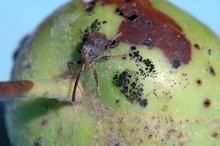
Apple curculio feeding impairment - Occasional crusade of "wormy" and dropped fruit.
- It is a species of weevil; adults have a distinctive snout and are ruddy to brown in color.
- Adults lay eggs inside developing apples shortly after petals fall, which causes scarring on the apple tree'south skin. If you are treating copse for plum curculio, apple curculio may also be controlled.
- Larvae burrow into the fruit to feed on the developing seeds, causing apples to rot and driblet off of the tree.
- Adults await out the winter in sheltered areas.
- Removing dropped fruit helps reduce adjacent year'due south population.
- Spraying for plum curculio shortly afterwards petal fall likewise manages apple tree curculio.
The 2 primary diseases affecting apples in the upper Midwest are apple scab and burn down blight.
- The easiest way to prevent these diseases is to plant resistant varieties.
- If you plant susceptible varieties, there are means to forestall and manage infection.
- Keep the area around apple trees tidy and free of debris, fallen fruit and leaves, pruned branches, and weeds throughout the year.
Apple scab
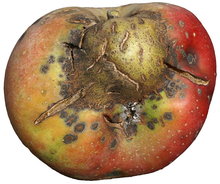
The commencement signs of this disease can oft be found on the undersurface of the leaves every bit they emerge from the buds in the bound.
- Apple scab spores are diddled around in the air and land on the undersurface of leaves.
- As the leaves continue to abound, both surfaces can exist infected as tin the fruit.
- The signs to look for on leaves are velvety, dark-brown, small circles.
- As the infection takes hold, these lesions outset to grow together and the surfaces of leaves and fruit become distorted.
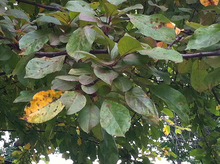
Keeping scab infection to a minimum begins with raking and removing leaves from nether the tree the previous fall. Planting varieties that are resistant to scab is some other way to minimize infection. William's Pride, Freedom, and Liberty are immune to this illness. Honeycrisp has some immunity besides.
If the diverseness you plant is not allowed and you run into signs of scab early in the season, the best way to protect the fruit is by covering it with a plastic purse or applying a well-timed spray of organic fungicides such as lime sulfur.
Burn blight
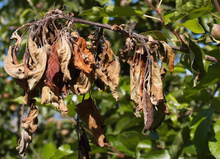
Burn bane is caused by a bacterial infection that can kill blossoms, shoots, and eventually entire trees. Yous might encounter this disease on the trunk or limbs of a tree as a sunken area with discolored bark. Every bit the lesion gets bigger, it begins to crack around the edges and the tree will wait like it has been burned.
You lot also might meet the disease developing on new shoots as they grow in the late spring. When shoots are infected, they turn from dark-green to brown to black, also appearing equally if burned. The shoot will develop a crook at the end of the shoot.
The all-time approach to managing fire bane is prevention.
- Establish fire blight resistant varieties.
- Institute trees in a spot that is well-drained and has total sun and enough of air circulation.
- Go along the surface area around the tree very clean and free of fallen fruit and foliage, pruning droppings, and weeds.
Burn down blight is about prevalent in young, fast-growing copse. If yous see symptoms of the disease, timing is critical because the disease moves quickly through the tree.
- Clip out infected shoots at least half dozen inches behind the browning surface area of that shoot.
- After each pruning cut, disinfect pruners in a dilute bleach solution so you don't spread the infection with your pruners.
- If branches have burn down blight lesions, prune those out well backside the infected area. This may impact the wait of your tree, just it will potentially salve the life of your tree.
- Avoid difficult pruning while the tree is young (up to 3 years) and limit nitrogen fertilizers, both of which crusade excessive growth.
Minor mammals might discover your newly planted apple tree trees in wintertime and chew on the young bark. This can exist prevented past wrapping the trunk with plastic tree guards or putting a hardware textile cage effectually the trunks. Plastic screw tree guards are easy to utilize and forbid voles and rabbits from feeding on the bark.
- Push plastic tree guards or hardware cloth cages into the soil to a depth of two inches.
- Loosen plastic spiral guards periodically to permit the tree to expand and to keep moisture from building up around the trunk.
- Once the tree has crude and flaky mature bark, chewing animals volition not damage information technology, so tree guards can exist removed.
Deer can also be problematic, chewing on young branches of apple trees or rubbing antlers on the trunks.
- Put a ring of fencing around the tree, especially in winter, to prevent impairment.
- Make the argue tall enough then the deer tin can't reach over the top to nibble branches.
- If you lot have a lot of trees and significant deer populations, information technology would exist wise to fence your entire planting.
Read more than about how to protect your copse from deer.
Winter damage
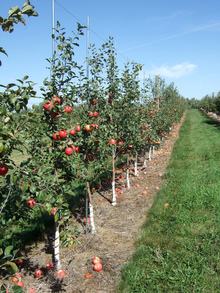
Wintertime injury is acquired when a tree'due south bark temperature gets above freezing and water in the tissues under the bark becomes liquid and begins to flow through the cells. When the sunday goes down or behind a cloud, the liquid water suddenly freezes, dissentious the cells and sometimes killing the tissue on one side of the trunk.
White plastic tree guards or tree wrap can help foreclose winter injury or sunscald to immature trees.
- The white fabric reflects sunlight from the trunk, which helps prevent the torso from heating up on a common cold, sunny winter day.
- Tree guards tin can be removed once the bawl becomes thick and scaly, after about 6 to viii years.
- In the meantime, loosen the guard periodically to permit the tree to expand.
- A good practice is to remove the tree guard for the growing season and put it dorsum on in the autumn.
Hail damage
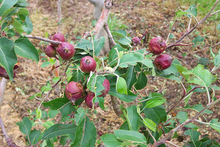
Hail is common in the upper Midwest, occurring at times during the pinnacle of summer. Depending on the size of the hail, time of year, and duration of the hail event, damage can occur on flowers, fruit, foliage, shoots and branches.
- In many cases damage to the tree itself is minimal, and the tree tin can usually recover.
- Monitor the tree for whatsoever damaged areas that start to change colour or spread.
- Hail might crusade splits in the bark of shoots and branches, making the tree susceptible to diseases.
- Clip out severely damaged branches immediately.
- Practise not fertilize a hail damaged tree. This would result in excessive vegetative growth, and increase the risk of diseases.
- Remove damaged or split fruit as open wounds can concenter insect pests and increase chance of disease infection.
- If fruit is dented it should be okay, and is worth keeping on the tree. It may effect in a bruise that can be cutting out before eating.
Sunburn and sunburn necrosis
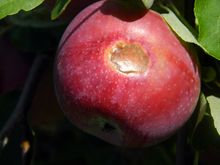
Sunburnt apples develop a big brown blemish on the side of the fruit that is exposed to direct sunlight. It is most common for fruit on the southwest side of the tree to exhibit sunburn.
Sunburn may occur during periods of very sunny, hot weather.
Fruits on the outside of the tree are more susceptible to sunburn than fruits on the inside of the tree, because they are not beingness shaded by every bit many leaves. Withal, they likewise by and large ripen faster.
If temperatures exceed 90 degrees F in combination with directly sunlight, apples can likewise brainstorm to rot at the location of the sunburn. This is called "sunburn necrosis." Necrosis is non as common as sunburn browning in Minnesota considering temperatures do not oftentimes get over 90 degrees.
Reviewed in 2021
Source: https://extension.umn.edu/fruit/growing-apples
0 Response to "Is Tree From Line Freezes Will It Ever Grow Limes Ever Again Will It Produce Food Afterwards"
Enregistrer un commentaire