When Was the Battle Agains the Heshians George Washington
The Battle of Trenton was a small but pivotal American Revolutionary War battle that took identify on the morning time of December 26, 1776, in Trenton, New Jersey. After General George Washington's crossing of the Delaware River north of Trenton the previous dark, Washington led the primary body of the Continental Army confronting Hessian auxiliaries garrisoned at Trenton. Later on a brief battle, almost two-thirds of the Hessian strength was captured, with negligible losses to the Americans. The boxing significantly additional the Continental Army's waning morale, and inspired re-enlistments.
The Continental Regular army had previously suffered several defeats in New York and had been forced to retreat through New Jersey to Pennsylvania. Morale in the army was depression; to end the year on a positive annotation, George Washington—Commander-in-Main of the Continental Army—devised a plan to cross the Delaware River on the night of Dec 25–26 and surround the Hessians' garrison.
Because the river was icy and the weather severe, the crossing proved dangerous. Two detachments were unable to cantankerous the river, leaving Washington with just 2,400 men under his control in the assault, iii,000 fewer than planned. The ground forces marched 9 miles (fourteen.5 km) south to Trenton. The Hessians had lowered their guard, thinking they were safety from the Americans' regular army, and had no long-distance outposts or patrols. Washington'south forces caught them off guard, and subsequently a short but tearing resistance, most of the Hessians surrendered and were captured, with just over a third escaping across Assunpink Creek.
Despite the battle'south small numbers, the victory inspired patriots and sympathizers of the newly formed United States. With the success of the ongoing revolution in dubiousness a week before, the ground forces had seemed on the verge of collapse. The dramatic victory inspired soldiers to serve longer and attracted new recruits to the ranks.
Background [edit]
In early December 1776, American morale was very low.[6] The Americans had been ousted from New York past the British and their Hessian auxiliaries, and the Continental Army was forced to retreat across New Jersey. Ninety percent of the Continental Army soldiers who had served at Long Island were gone.[vii] Men had deserted, feeling that the cause for independence was lost. Washington, Commander-in-Primary of the Continental Army, expressed some doubts, writing to his cousin in Virginia, "I think the game is pretty near upwards."[8]
At the time a small-scale town in New Bailiwick of jersey, Trenton was occupied by four regiments of Hessian soldiers (numbering about 1,400 men) commanded by Colonel Johann Rall. Washington'south force comprised two,400 men, with infantry divisions commanded past Major Generals Nathanael Greene and John Sullivan, and artillery under the direction of Brigadier General Henry Knox.[9]
Prelude [edit]
Intelligence [edit]
George Washington had stationed a spy named John Honeyman, posing as a Tory, in Trenton. Honeyman had served with Major General James Wolfe in Quebec at the Battle of the Plains of Abraham on September thirteen, 1759, and had no problem establishing his credentials every bit a Tory. Honeyman was a butcher and bartender, who traded with the British and Hessians. This enabled him to gather intelligence and to convince the Hessians that the Continental Ground forces was in such a depression country of morale that they would not assail Trenton. Shortly before Christmas, he arranged to be captured past the Continental Army, who had orders to bring him to Washington unharmed. After existence questioned by Washington, he was imprisoned in a hut to be tried equally a Tory in the morning, but a small burn down broke out nearby, enabling him to "escape".[10] On the evening before the battle, Hessian commander Rall, was celebrating Christmas with his troops at the farm of Abraham Chase, a wealthy merchant and farmer of Trenton. Hunt played the office of a friendly Loyalist host, giving Rall a false sense of serenity while Washington and his troops were preparing for a surprise assault.[11]
U.S. plan [edit]

The U.S. plan of attack under Washington
The U.S. program relied on launching coordinated attacks from three directions. General John Cadwalader would launch a diversionary attack confronting the British garrison at Bordentown, New Jersey, to block off reinforcements from the south. General James Ewing would take 700 militia beyond the river at Trenton Ferry, seize the bridge over the Assunpink Creek and prevent enemy troops from escaping. The main assault forcefulness of ii,400 men would cross the river 9 mi (fourteen km) north of Trenton and divide into two groups, one under Greene and one nether Sullivan, to launch a pre-dawn set on.[12] Sullivan would assault the boondocks from the south, and Greene from the north.[7] Depending on the success of the functioning, the Americans would possibly follow upwardly with separate attacks on Princeton and New Brunswick.[6]
During the calendar week before the battle, U.S. advance parties began to ambush enemy cavalry patrols, capturing acceleration riders and attacking Hessian pickets. The Hessian commander, to emphasize the danger his men were facing, sent 100 infantry and an artillery detachment to deliver a letter of the alphabet to the British commander at Princeton.[vi] Washington ordered Ewing and his Pennsylvania militia to try to gain information on Hessian movements and applied science.[13] Ewing instead made three successful raids across the river. On Dec 17 and 18, 1776, they attacked an outpost of jägers and on the 21st, they set fire to several houses.[xiii] Washington put constant watches on all possible crossings well-nigh the Continental Army encampment on the Delaware, as he believed William Howe would launch an assail from the n on Philadelphia if the river froze over.[14]
On December 20, 1776, some 2,000 troops led by General Sullivan arrived in Washington's camp.[xv] They had been under the command of Charles Lee and had been moving slowly through northern New Jersey when Lee was captured. That same day, an additional 800 troops arrived from Fort Ticonderoga nether the command of Horatio Gates.[15]
Hessian moves [edit]

The Hessian Sketch of the Battle of Trenton
On December 14, 1776, the Hessians arrived in Trenton to establish their wintertime quarters.[sixteen] At the time, Trenton was a small town with most 100 houses and two main streets, King (now Warren) Street and Queen (now Broad) Street.[17] Carl von Donop, Rall's superior, had marched due south to Mount Holly on December 22 to deal with the resistance in New Bailiwick of jersey, and had clashed with some New Jersey militia at that place on December 23.[18]
Donop, who despised Rall, was reluctant to requite control of Trenton to him.[xix] Rall was known to be loud and unacquainted with the English,[19] just he was also a 36-year veteran with a great deal of boxing experience. His asking for reinforcements had been turned down by British commander General James Grant, who disdained the American rebels and thought them poor soldiers. Despite Rall's feel, the Hessians at Trenton did not admire their commander.[20]
Trenton lacked city walls or fortifications, which was typical of U.S. settlements.[21] Some Hessian officers advised Rall to fortify the town, and 2 of his engineers advised that a redoubt exist constructed at the upper stop of town and fortifications be built along the river.[21] The engineers went so far as to draw up plans, simply Rall disagreed with them.[21] When Rall was again urged to fortify the town, he replied, "Let them come ... We will go at them with the bayonet."[21]
As Christmas approached, Loyalists came to Trenton to written report the Americans were planning action.[8] U.Due south. deserters told the Hessians that rations were being prepared for an advance across the river. Rall publicly dismissed such talk every bit nonsense, but privately in messages to his superiors, he said he was worried most an imminent assail.[8] He wrote to Donop that he was "liable to be attacked at any moment". Rall said that Trenton was "indefensible" and asked that British troops establish a garrison in Maidenhead (now Lawrenceville). Close to Trenton, this would help defend the roads from Americans. His request was denied.[22] As the Americans disrupted Hessian supply lines, the officers started to share Rall's fears. I wrote, "We have non slept one night in peace since we came to this identify."[23] On December 22, 1776, a spy reported to Grant that Washington had called a council of war; Grant told Rall to "exist on your baby-sit".[24]
The master Hessian force of one,500 men was divided into three regiments: Knyphausen, Lossberg and Rall. That night, they did not send out whatever patrols considering of the severe conditions.[25]
Crossing and march [edit]

Before Washington and his troops left, Benjamin Rush came to cheer upwardly the general. While he was there, he saw a notation Washington had written, saying, "Victory or Decease".[23] Those words would be the countersign for the surprise attack.[26] Each soldier carried 60 rounds of armament, and three days of rations.[27] When the army arrived at the shores of the Delaware, they were already behind schedule, and clouds began to form to a higher place them.[28] It began to rain. Equally the air'south temperature dropped, the pelting changed to sleet, and so to snow.[28] The Americans began to cantankerous the river, with John Glover in command. The men went beyond in Durham boats, while the horses and arms went across on big ferries.[29] The 14th Continental Regiment of Glover manned the boats. During the crossing, several men fell overboard, including Colonel John Haslet. Haslet was quickly pulled out of the water. No one died during the crossing, and all the artillery pieces fabricated it over in adept condition.[30]
Ii small detachments of infantry of about twoscore men each were ordered alee of main columns.[31] They set roadblocks ahead of the chief ground forces and were to take prisoner whoever came into or left the town.[31] One of the groups was sent n of Trenton, and the other was sent to block River Route, which ran along the Delaware River to Trenton.[32]
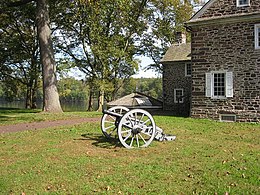
Cannon at Washington's Crossing Historic Park
The terrible weather conditions delayed the landings in New Bailiwick of jersey until 3:00 am; the programme was that they were supposed to be completed by 12:00 am. Washington realized it would be impossible to launch a pre-dawn attack. Some other setback occurred for the Americans, as generals Cadwalader and Ewing were unable to join the attack because of the atmospheric condition conditions.[12]
At iv:00 am, the soldiers began to march towards Trenton.[33] Along the way, several civilians joined every bit volunteers and led as guides (such equally John Mott) because of their knowledge of the terrain.[34] After marching 1.5 miles (ii.iv km) through winding roads into the air current, they reached Acquit Tavern, where they turned south onto Bear Tavern Road .[35] The ground was slippery, merely it was level, making it easier for the horses and artillery. They began to brand ameliorate fourth dimension.[35] They presently reached Jacobs Creek, where, with difficulty, the Americans made information technology across.[36] The 2 groups stayed together until they reached Birmingham (at present West Trenton), where they dissever apart, with Greene'southward force heading east to approach Trenton by the Scotch and Pennington roads and Sullivan'south heading southwest to approach via River Road.[7] Before long after, they reached the business firm of Benjamin Moore, where the family offered nutrient and beverage to Washington. At this point, the first signs of daylight began to appear.[37] Many of the troops did not have boots, so they were forced to wear rags around their feet. Some of the men's feet bled, turning the snow to a night red. 2 men died on the march.[38]
As they marched, Washington rode up and downwards the line, encouraging the men to continue.[29] Full general Sullivan sent a courier to tell Washington that the weather was wetting his men's gunpowder. Washington replied, "Tell Full general Sullivan to use the bayonet. I am resolved to take Trenton."[39]
About ii miles (3 km) outside the boondocks, the main columns reunited with the advance parties.[twoscore] They were startled by the sudden appearance of 50 armed men, but they were American. Led past Adam Stephen, they had not known about the plan to attack Trenton and had attacked a Hessian outpost.[41] Washington feared the Hessians would have been put on baby-sit, and shouted at Stephen, "You sir! You lot Sir, may have ruined all my plans by having them put on their guard."[41] Despite this, Washington ordered the accelerate continue to Trenton. In the result, Rall thought the outset raid was the attack which Grant had warned him about, and that there would be no further activity that day.[42]
Battle [edit]
U.S. set on [edit]
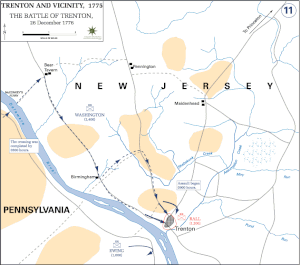
The Battle of Trenton, December 26, 1776

The engraving George Washington at the Boxing of Trenton past the Illman Brothers in 1870
At eight am, the outpost was set up by the Hessians at a cooper shop on Pennington Road about one mile northwest of Trenton. Washington led the assault, riding in front end of his soldiers.[43] Equally the Hessian commander of the outpost, Lieutenant Andreas Wiederholdt, left the shop, an American fired at him but missed.[43] Wiederholdt immediately shouted, "Der Feind!" (The Enemy!) and other Hessians came out.[44] The Americans fired three volleys, and the Hessians returned 1 of their own.[43] Washington ordered Edward Hand's Pennsylvania Riflemen and a battalion of German-speaking infantry to block the road that led to Princeton. They attacked the Hessian outpost there.[44] Wiederholdt soon realized that this was more than a raiding party; seeing other Hessians retreating from the outpost, he led his men to exercise the same.[45] Both Hessian detachments made organized retreats, firing every bit they barbarous back.[44] On the high footing at the north end of Trenton, they were joined by a duty company from the Lossberg Regiment.[44] They engaged the Americans, retreating slowly, keeping up continuous fire and using houses for comprehend.[46] One time in Trenton, they gained roofing fire from other Hessian baby-sit companies on the outskirts of the town. Some other guard company nearer to the Delaware River rushed east to their aid, leaving open the River Road into Trenton. Washington ordered the escape route to Princeton be cutting off, sending infantry in battle formation to block it, while artillery formed at the caput of King and Queen streets.[47]
Leading the southern U.S. cavalcade, Full general Sullivan entered Trenton by the abandoned River Route and blocked the only crossing over the Assunpink Creek to cut off the Hessian escape.[48] Sullivan briefly held up his accelerate to make sure Greene's division had time to drive the Hessians from their outposts in the north.[48] Soon after, they continued their advance, attacking the Hermitage, home of Philemon Dickinson, where fifty jägers nether the command of Lieutenant von Grothausen were stationed.[48] Lieutenant von Grothausen brought 12 of his jägers into action against the avant-garde guard but had only advanced a few hundred yards when he saw a column of Americans advancing to the Hermitage.[48] Pulling back to the Hessian barracks, he was joined by the balance of the jägers. Later on the exchange of 1 volley, they turned and ran, some trying to swim across the creek, while others escaped over the bridge, which had non yet been cut off. The twenty British dragoons also fled.[48] Equally Greene and Sullivan's columns pushed into the town, Washington moved to high basis n of King and Queens streets to run across the activeness and direct his troops.[49] By this time, U.S. artillery from the other side of the Delaware River had come into action, devastating the Hessian positions.[l]
With the sounding of the warning, the iii Hessian regiments began to fix for battle.[51] The Rall regiment formed on lower King Street along with the Lossberg regiment, while the Knyphausen regiment formed at the lower stop of Queen Street.[51] Lieutenant Piel, Rall's brigade adjutant, woke his commander, who plant that the rebels had taken the "V" of the main streets of the town. This is where the engineers had recommended building a redoubt. Rall ordered his regiment to form upwards at the lower end of King Street, the Lossberg regiment to prepare for an advance upward Queen Street, and the Knyphausen regiment to stand by as a reserve for Rall'south advance upward King Street.[48]
The U.S. cannon stationed at the caput of the two principal streets soon came into activeness. In reply, Rall directed his regiment, supported by a few companies of the Lossberg regiment, to clear the guns.[52] The Hessians formed ranks and began to accelerate up the street, just their formations were apace broken by the U.Due south. guns and fire from Mercer's men who had taken houses on the left side of the street.[52] Breaking ranks, the Hessians fled. Rall ordered two three-pound cannons into action. Subsequently getting off six rounds each, within just a few minutes, half of the Hessians manning their guns were killed by the U.S. cannon.[52] After the men fled to embrace behind houses and fences, their cannons were taken by the Americans.[53] Following capture of the cannons, men under the command of George Weedon advanced down Male monarch Street.[48]
On Queen Street, all Hessian attempts to advance upward the street were repulsed by guns under the command of Thomas Forrest. After firing four rounds each, two more Hessian guns were silenced. 1 of Forrest'south howitzers was put out of action with a broken axle.[48] The Knyphausen regiment became separated from the Lossberg and the Rall regiments. The Lossberg and the Rall regiments fell back to a field outside of town, taking heavy losses from grapeshot and musket burn. In the southern part of the town, Americans under command of Sullivan began to overwhelm the Hessians. John Stark led a bayonet charge at the Knyphausen regiment, whose resistance bankrupt considering their weapons would not burn. Sullivan led a column of men to block off escape of troops across the creek.[53]
Hessian resistance collapses [edit]
The Hessians in the field attempted to reorganize and brand one last attempt to retake the town so they could brand a breakout.[1] Rall decided to attack the U.South. flank on the heights due north of the town.[54] Rall yelled "Forward! Advance! Advance!", and the Hessians began to move, with the brigade'southward band playing fifes, bugles and drums to help the Hessians' spirit.[54] [55]
Washington, all the same on high ground, saw the Hessians approaching the U.S. flank. He moved his troops to assume battle formation against the enemy.[54] The two Hessian regiments began marching toward King Street but were caught in U.S. fire that came at them from three directions.[54] Some Americans had taken up defensive positions inside houses, reducing their exposure. Some civilians joined the fight against the Hessians.[56] Despite this, they connected to push, recapturing their cannons. At the head of Male monarch Street, Knox saw the Hessians had retaken the cannons and ordered his troops to take them. Half-dozen men ran and, later on a brief struggle, seized the cannons, turning them on the Hessians.[57] With most of the Hessians unable to fire their guns, the assail stalled. The Hessians' formations bankrupt, and they began to besprinkle.[56] Rall was mortally wounded.[58] Washington led his troops down from loftier footing while yelling, "March on, my brave fellows, after me!"[56] Most of the Hessians retreated into an orchard, with the Americans in shut pursuit. Speedily surrounded,[59] the Hessians were offered terms of surrender, to which they agreed.
Although ordered to join Rall, the remains of the Knyphausen regiment mistakenly marched in the opposite direction.[59] They tried to escape across the span only found it had been taken. The Americans rapidly swept in, defeating a Hessian attempt to interruption through their lines. Surrounded by Sullivan'southward men, the regiment surrendered, just minutes after the balance of the brigade.[60]
Casualties and capture [edit]

The Hessian forces lost 22 killed in action, including their commander Colonel Johann Rall, 83 wounded, and 896 captured–including the wounded.[61] The Americans suffered only two deaths during the march and five wounded from battle, including a near-fatal shoulder wound to hereafter president James Monroe. Other losses incurred by the patriots from exhaustion, exposure, and illness in the following days may have raised their losses to a higher place those of the Hessians.[62]
The captured Hessians were sent to Philadelphia and later Lancaster. In 1777 they were moved to Virginia.[63] Rall was mortally wounded and died later that dark at his headquarters.[62] All four Hessian colonels in Trenton were killed in the boxing. The Lossberg regiment was effectively removed from the British forces. Parts of the Knyphausen regiment escaped to the due south, but Sullivan captured some 200 boosted men, along with the regiment'southward cannon and supplies. They too captured approximately 1,000 arms and much-needed ammunition.[64] The Americans also captured their entire shop of provisions—tons of flour, dried and salted meats, ale and other liquors, as well every bit shoes, boots, article of clothing and bedding—things that were as much needed by the ragtag Continental forces, such as weapons and horses.
Among those captured by the Patriots was Christian Strenge, afterward to become a schoolmaster and fraktur artist in Pennsylvania.[65]
Hessian drinking [edit]
An officer in Washington's staff wrote earlier the battle, "They make a great deal of Christmas in Germany, and no doubt the Hessians will drinkable a not bad deal of beer and have a trip the light fantastic toe to-dark. They volition be sleepy to-morrow morning."[66] Popular history commonly portrays the Hessians as drunk from Christmas celebrations. However, historian David Hackett Fischer quotes Patriot John Greenwood, who fought in the battle and supervised Hessians afterward, who wrote, "I am certain not a driblet of liquor was drunkard during the whole night, nor, as I could see, even a slice of bread eaten."[67] Military historian Edward K. Lengel wrote, "The Germans were dazed and tired but there is no truth to the fable claiming that they were helplessly drunkard."[68]
Backwash [edit]
After the Hessians' surrender, Washington is reported to have shaken the paw of a immature officer and said, "This is a glorious twenty-four hour period for our country."[69] On December 28, General Washington interviewed Lieutenant (later on Colonel) Andreas Wiederhold, who detailed the failures of Rall's grooming.[seventy] Washington soon learned all the same that Cadwalader and Ewing had been unable to complete their crossing, leaving his worn-out army of 2,400 men isolated.[71] Without their ii,600 men, Washington realized he did non have the forces to assail Princeton and New Brunswick.[71]
By noon, Washington's force had moved across the Delaware back into Pennsylvania, taking their prisoners and captured supplies with them.[71] Washington would follow upward his success a week afterwards in the Battle of the Assunpink Creek and the Battle of Princeton solidifying Patriot gains.
Legacy [edit]

This small but decisive battle, as with the subsequently Battle of Cowpens, had an effect asymmetric to its size. The Patriot victory gave the Continental Congress new confidence, every bit it proved colonial forces could defeat regulars. It also increased re-enlistments in the Continental Army forces. By defeating a European ground forces, the colonials reduced the fearfulness which the Hessians had caused earlier that yr subsequently the fighting in New York.[ane] Howe was stunned that the Patriots so easily surprised and overwhelmed the Hessian garrison.[threescore] Colonial support for the rebellion was further buoyed significantly at this fourth dimension by writings of Thomas Paine and additional successful deportment by the New Jersey Militia.[72]
Two notable U.Due south. officers were wounded while leading the charge down King Street: William Washington, cousin of General Washington, and Lieutenant James Monroe, the hereafter President of the Usa. Monroe was carried from the field haemorrhage badly later he was struck in the left shoulder by a musket brawl, which severed an artery. Dr. John Riker clamped the avenue, preventing him from bleeding to death.[57]
The Trenton Battle Monument, erected at "Five Points" in Trenton, stands as a tribute to this U.S. victory.[73] The crossing of the Delaware River and boxing are reenacted by local enthusiasts every yr (unless the weather is too severe on the river).[74]
Eight current Army National Guard units (101st Eng Bn,[75] 103rd Eng Bn,[76] A/1-104th Cav,[77] 111th Inf,[78] 125th QM Co,[79] 175th Inf,[80] 181st Inf[81] and 198th Sig Bn[82]) and one currently-active Regular Regular army Artillery battalion (one–5th FA)[83] are derived from U.S. units that participated in the Battle of Trenton. There are thirty current units of the U.Southward. Army with colonial roots.
Painting [edit]
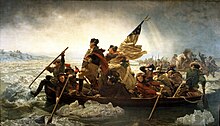
In 1851, German-American artist Emanuel Leutze painted the second of iii paintings depicting Washington crossing the Delaware. Information technology is in the Metropolitan Museum of Fine art, and is "ane of the almost famous American paintings." At the time of its first exhibition it caused a sensation, in Europe and the Usa. Leutze hoped it would stir revolutionary sentiments in Germany. Later on half-dozen months in Germany information technology was shipped to New York City where the New-York Mirror newspaper lauded it with the words, "the grandest, almost majestic, and most effective painting e'er exhibited in America."[84] The painting is the center-slice of the collections in the American Wing. Information technology is notwithstanding one of the almost recognizable paintings at the Metropolitan. It is central to the canon of American historical art images, its awe-inspiring popularity undimmed in the years since it was first exhibited.[85]
See also [edit]
- American Revolutionary War British New York counter-offensive. The 'Battle of Trenton' placed in overall sequence and strategic context.
- List of American Revolutionary War battles
- New Jersey in the American Revolution
- Boxing of the Assunpink Creek – besides known as the Second Boxing of Trenton, fought ane calendar week later
- Battle of Fe Works Hill
- Battle of Princeton – fought the day after the Boxing of the Assunpink Creek
- Battle of Yorktown
- Battles of Saratoga
- Battle of Bennington
Footnotes [edit]
- ^ a b c Wood p. 72
- ^ Fischer, 2006, pp. 391–393
- ^ Fischer, 2006, p. 396
- ^ Fischer, 2006, p. 406
- ^ Fischer, 2006,, p. 254. Prey numbers vary slightly with the Hessian forces, commonly betwixt 21–23 killed, 80–95 wounded and 890–920 captured (including the wounded), but it is more often than not agreed that the casualties were in this surface area.
- ^ a b c Brooks, 1999, p. 55
- ^ a b c Savas p. 84
- ^ a b c Ketchum, 1999, p. 235
- ^ Stanhope, 1854 p. 129
- ^ Van Dyke, John (1873), "An Unwritten Account of a Spy of Washington", Our Home
- ^ Schuyler, 1929, p. 132
- ^ a b Brooks, 1999, p. 56
- ^ a b Fischer, 2006, p. 195
- ^ Ketchum, 1999, p. 242
- ^ a b Savas, 2006, p. 83
- ^ Fischer, 2006, p. 188
- ^ Ketchum, 1999, p. 233
- ^ Rosenfeld, 2007 p. 177
- ^ a b Ketchum, 1999, p. 229
- ^ Lengel, 2005, p. 183
- ^ a b c d Fischer, 2006, p. 189
- ^ Fischer, 2006, p. 197
- ^ a b Ketchum, 1999, p. 236
- ^ Fischer, 2006, p. 203
- ^ Wood p. 65
- ^ McCullough 2006, p. 273
- ^ McCullough 2006, p. 274
- ^ a b Fischer, 2006, p. 212
- ^ a b Ferling, 2007, p. 176
- ^ Fischer, 2006, p. 219
- ^ a b Fischer, 2006, p. 221
- ^ Fischer, 2006, p. 222
- ^ Fischer, 2006, p. 223
- ^ Fischer, 2006, p. 225
- ^ a b Fischer, 2006, p. 226
- ^ Fischer, 2006, p. 227
- ^ Fischer, 2006, p. 228
- ^ Scheer p. 215
- ^ Kevin Wright. "The Crossing And Battle At Trenton – 1776". Bergen County Historical Society. Retrieved August 14, 2008.
- ^ Fischer, 2006, p.231
- ^ a b Fischer, 2006, p. 232
- ^ McCullough 2006, p. 279
- ^ a b c Fischer, 2006, p. 235
- ^ a b c d Fischer, 2006, p. 237
- ^ Andreas Wiederholdt (edited by M.D. Learned and C. Grosse): Tagebuch des Capt. Wiederholdt Vom 7 Oktober bis vii Dec 1780; The MacMillan Co, New York, ~1862; reprinted past the Academy of Michigan Library, 17 August 2015
- ^ Ketchum, 1999, p. 255
- ^ Ketchum, 1999, p. 256
- ^ a b c d eastward f g h Forest p. 68
- ^ McCullough 2006, p. 280
- ^ Fischer, 2006, p. 239
- ^ a b Fischer, 2006, p. 240
- ^ a b c Woods p. 70
- ^ a b Wood p. 71
- ^ a b c d Fischer, 2006, p. 246
- ^ Ketchum, 1999, p. 262
- ^ a b c Fischer, 2006, p. 249
- ^ a b Fischer, 2006, p. 247
- ^ Fischer, 2006, p. 248
- ^ a b Fischer, 2006, p. 251
- ^ a b Wood p. 74
- ^ Fischer, 2006, p. 254
- ^ a b Fischer, 2006, p. 255
- ^ Fischer, 2006, p. 379
- ^ Mitchell, 2003, p. 43
- ^ Brooklyn United. "Johann Christian Strenge – Cocky-Taught Genius". selftaughtgenius.org . Retrieved April 6, 2019.
- ^ Stryker p. 361
- ^ Fischer, 2006, p. 426
- ^ Lengel, 2005, p. 186
- ^ Ferling, 2007, p. 178
- ^ Andreas Wiederholdt (edited by M.D. Learned and C. Grosse: Tagebuch des Capt. Widerholdt Vom 7 Oktober bis 7 December 1780; The MacMillan Co, New York, ~1862;reprinted by the University of Michigan Library, 17 August 2015
- ^ a b c Woods p. 75
- ^ Fischer, 2006, p. 143
- ^ Burt, 2001, p. 439
- ^ "Cross With U.s.a.". Washington Crossing Historic Park.
- ^ Department of the Ground forces, Lineage and Honors, 101st Engineer Battalion
- ^ Department of the Regular army, Lineage and Honors, 103rd Engineer Battalion.
- ^ Department of the Army, Lineage and Honors, Troop A/1st Squadron/104th Cavalry.
- ^ Department of the Army, Lineage and Honors, 111th Infantry. Reproduced in Sawicki 1981. pp. 217–219.
- ^ Department of the Ground forces, Lineage and Honors, 125th Quartermaster Company. "Archived copy". Archived from the original on December 18, 2014. Retrieved February 29, 2012.
{{cite web}}: CS1 maint: archived copy equally title (link) - ^ Department of the Army, Lineage and Honors, 175th Infantry. Reproduced in Sawicki 1982, pp. 343–345.
- ^ Section of the Army, Lineage and Honors, 181st Infantry. Reproduced in Sawicki 1981, pp. 354–355.
- ^ Department of the Army, Lineage and Honors, 198th Signal Battalion.
- ^ Department of the Army, Lineage and Honors, 1st Battalion, fifth Field Artillery. [1]
- ^ "10 Facts almost Washington'south Crossing of the Delaware River". George Washington's Mountain Vernon.
- ^ Barratt, Carrie; Mayer, Lance; Myers, Guy; Wilner, Eli; Smeaton, Suzanne (2012). Washington crossing the Delaware : restoring an American masterpiece. New York: Metropolitan Museum of Art. p. three. ISBN978-1-58839-439-two.
Bibliography [edit]
- Brooks, Victor (1999). How America Fought Its Wars. New York: Da Capo Press. ISBNane-58097-002-8.
- Burt, Daniel S. (2001). The Biography Volume. New York: Oryx Press. ISBN1-57356-256-four.
- Ferling, John (2007). Almost a Miracle. Oxford University Press. ISBN978-0-19-518121-0.
- Fischer, David Hackett (2006). Washington's Crossing. Oxford Academy Printing. ISBN0-nineteen-517034-ii.
- Ketchum, Richard (1999). The Winter Soldiers: The Battles for Trenton and Princeton (1st Owl books ed.). Holt Paperbacks. ISBN0-8050-6098-vii.
- Lengel, Edward (2005). General George Washington, a Armed services Life . New York: Random House Paperbacks. ISBN0-8129-6950-2.
- McCullough, David (2006). 1776 . New York: Simon and Schuster Paperback. ISBN0-7432-2672-0.
1776 David.
- Mitchell, Craig (2003). George Washington's New Jersey. Middle Atlantic Press. ISBN0-9705804-one-X.
- Rosenfeld, Lucy (2007). History Walks in New Jersey. Rutgers. ISBN978-0-8135-3969-0.
- Savas, Theodore (2006). Guide to the Battles of the American Revolution. Savas Beatie. ISBNone-932714-12-X.
- Sawicki, James A. (1981). Infantry Regiments of the U.s.a. Army. Dumfries, VA: Wyvern Publications. ISBN978-0-9602404-three-2.
- Scheer, George (1987). Rebels and Redcoats. Da Capo Press. ISBN0-306-80307-0.
- Schuyler, Hamilton (1929). A history of Trenton, 1679-1929. Princeton : Princeton University Press: The Trenton Historical Gild.
- Stanhope, Phillip Henry (1854). History of England: From the Peace of Utrecht to the Peace of Versailles. GB, Murray.
- Wiederholdt, Andreas (2015) [1862]. Chiliad.D. Learned; C. Grosse (eds.). Tagebuch des Capt. Wiederholdt vom seven Oktober bis 7 Dec 1780. The University of Michigan Library: The MacMillan Co, New York.
- Wood, West.J. Henry (2003). Battles of the Revolutionary State of war. Da Capo Press. ISBN0-306-81329-7.
- Tucker, Philip Thomas (2014), George Washington'southward Surprise Attack: A New Look at the Battle That Decided the Fate of America, Skyhorse Publishing, ISBN 978-1628736526
Farther reading [edit]
- Maloy, Marker. Victory or Expiry: The Battles of Trenton and Princeton, December 25, 1776 – Jan three, 1777. Emerging Revolutionary War Series. El Dorado Hills, CA: Savas Beatie, 2018. ISBN 978-1-61121-381-ii.
External links [edit]
- "The Two Battles of Trenton". The Trenton Historical Society.
- "The Wintertime Patriots: The Trenton-Princeton Campaign of 1776–1777". George Washington's Mount Vernon.
Coordinates: forty°thirteen′01″N 74°45′29″W / 40.217°Northward 74.758°Westward / xl.217; -74.758
Source: https://en.wikipedia.org/wiki/Battle_of_Trenton
0 Response to "When Was the Battle Agains the Heshians George Washington"
Enregistrer un commentaire